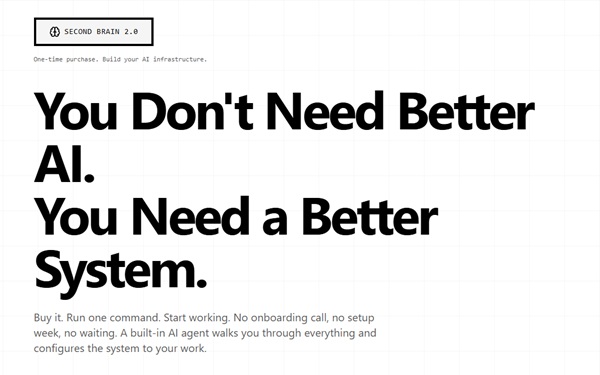
Second Brain 2.0 is poised to revolutionize the way individuals interact with artificial intelligence, shifting from generic cloud-based services to a profoundly personalized, context-aware system that resides directly on the user’s machine. This innovative platform addresses the crucial gap in current AI paradigms by providing persistent, local context, transforming AI from a passive assistant into an active, specialized teammate deeply integrated with a user’s unique operations.
Second Brain 2.0

The advent of Second Brain 2.0 marks a significant inflection point in the evolution of artificial intelligence, heralding a future where AI is not just intelligent, but intimately familiar with its user. It’s a bold departure from the predominant cloud-AI model, championing the idea that true AI efficacy stems not from incremental improvements in model capabilities, but from the depth and persistence of the context it can access. Imagine an AI that remembers every past interaction, understands your unique professional voice, and is privy to the intricate details of your workflows and business data – that is the promise and realization of this paradigm. This fundamental shift from generic interaction to hyper-personalized engagement is what positions Second Brain 2.0 as a transformative force, enabling professionals to leverage AI in ways previously confined to science fiction, all while retaining unwavering control over their most sensitive information.
The Paradigm Shift to Local AI and Context
The core philosophy underpinning Second Brain 2.0 challenges the very foundation of contemporary AI deployment. For years, the industry narrative has centered on the quest for “better AI models”—larger, more sophisticated neural networks capable of understanding increasingly complex prompts and generating more coherent responses. However, this platform posits that chasing marginal gains in model intelligence overlooks a more critical dimension: context. A brilliantly clever AI model remains largely unhelpful if it consistently starts from a blank slate, devoid of any memory of past conversations, user preferences, or relevant business data. The problem isn’t the hammer; it’s the lack of a familiar workspace and tools to use it effectively. By prioritizing a persistent, local context, Second Brain 2.0 transforms a powerful but generic tool into an indispensable extension of the individual.
This transformation is architecturally enabled through a robust local database infrastructure. Utilizing PocketBase, the system ensures that all critical data—ranging from CRM entries and proprietary knowledge bases to entire session histories—is stored securely on the user’s local machine, specifically within an SQLite file. This local-first approach serves two paramount functions: it drastically reduces latency to under 5ms, facilitating seamless offline functionality, and, more importantly, it reinforces data sovereignty. In an era where data privacy and intellectual property are increasingly vulnerable in the cloud, keeping information on the user’s machine provides an unassailable bulwark against unauthorized access and mitigates the risks associated with third-party server breaches. The Model Context Protocol (MCP) acts as the intelligent conduit, allowing AI agents to tap into this rich, local data pool, ensuring every interaction is informed and relevant.
The practical outcomes of this paradigm shift are profound and immediate. What once took weeks or even months to set up—integrating a new AI tool into a complex workflow—is now compressed into minutes through a simple command-line interface. This rapid deployment, coupled with the contextual depth, means AI is no longer a generic assistant offering broad, often unhelpful advice. Instead, it evolves into a specialized teammate, capable of understanding the nuances of an individual’s specific needs, historical interactions, and professional voice. From intricate CRM management and nuanced email automation to on-brand content creation, Second Brain 2.0 empowers users with an AI that doesn’t just perform tasks, but understands the why and how behind them, acting almost telepathically within the user’s operational framework. It’s an investment in building an AI that truly knows you, rather than repeatedly introducing yourself to a stranger.
Rapid Implementation and Agent-Led Configuration
One of the most compelling features of Second Brain 2.0 is its commitment to immediate utility, offering a stark contrast to the often cumbersome onboarding processes associated with traditional AI and SaaS platforms. The philosophy here is simple: if a tool is difficult to set up, its potential remains largely untapped. This system dismantles that barrier with a deployment model so streamlined it feels almost instantaneous. Users are not subjected to extensive onboarding documentation or multi-day configuration sprints. Instead, the process is initiated by a swift act: cloning the repository and executing a single /start command. This elegant simplicity is central to its appeal, moving directly from curiosity to a functional, personalized AI environment, which for many, is a breath of fresh air in a landscape of endless setup wizards and complex integrations.
Further cementing its rapid deployment capability is the innovative role of a built-in AI agent. This isn’t merely a passive installer program; it’s an intelligent entity, connected via the Model Context Protocol (MCP), that actively engages with the user. Upon initiation, this agent conducts an “interview,” a guided conversational process designed to understand the user’s specific work patterns, professional goals, existing workflows, and explicit preferences. This intelligent configuration process is revolutionary, as it eliminates the need for manual tweaking, labyrinthine settings menus, or the trial-and-error often associated with personalizing new software. The AI agent effectively learns about the user from the user, then autonomously configures the entire system, tailoring everything from default responses to specialized agent roles to perfectly align with their operational needs.
The cumulative effect of this design philosophy is an unprecedented deployment speed. For most users, the journey from initial installation to running their very first automated workflow is astonishingly short, often completed within 30 minutes. This isn’t just a technical achievement; it’s a powerful psychological one. The immediate gratification derived from seeing a complex AI system tailored and operational in such a short span dramatically reduces user friction and increases adoption rates. It transforms the often-dreaded “setup phase” into an engaging, interactive experience, where the user immediately perceives the value and personalized nature of the tool. This immediate utility fosters a sense of empowerment and effectiveness right from the outset, enabling professionals to quickly Build your AI Infrastructure and begin leveraging its capabilities without delay, turning initial skepticism into enthusiastic engagement.
Persistent Context – Redefining AI Interaction
The most debilitating flaw of generic AI interactions is what Second Brain 2.0 refers to as the “zero-context problem.” Every new conversation with a cloud-based AI largely begins from a blank slate. While some models retain short-term memory within a single chat session, they rarely carry over long-term details, preferences, nuances of communication style, or historical data from prior, unrelated interactions.
This forces users into a perpetual cycle of re-explanation, re-contextualization, and re-setting the stage for every request, squandering valuable time and significantly diluting the potential efficacy of the AI. Second Brain 2.0 explicitly tackles this by maintaining a rich, local database of everything relevant to the user—preferences, unique voice patterns, a comprehensive history of interactions, and proprietary business data. This persistent context mechanism fundamentally modifies AI behavior, allowing it to evolve into a truly personalized and proactive assistant.
To truly grasp the transformative power of persistent context, consider a few illustrative scenarios that highlight the stark difference between generic cloud AI and the contextual intelligence offered by Second Brain 2.0. Imagine preparing for a crucial sales meeting: without Second Brain 2.0, a generic AI might offer superficial tips on sales best practices or conduct basic public company research. With Second Brain 2.0, that same AI, now deeply embedded in your local CRM and equipped with historical interaction data, can analyze past discussions with the client, identify key decision-makers’ communication styles, reference specific deal frameworks that yielded success in similar situations, and even suggest personalized talking points based on the client’s previous engagement patterns. It moves from providing generic advice to actionable, hyper-relevant intelligence tailored to your unique sales pipeline.
Similarly, in content creation, the difference is night and day. A generic AI might produce a list-based productivity post, indistinguishable from thousands of others online. However, an AI powered by Second Brain 2.0 can reference your specific past experiences, analyze your unique authorial voice from previous articles, and apply established post structures that have historically resonated with your audience. It assists in crafting content that is authentically yours, deeply personalized and aligned with your brand, rather than generic boilerplate.
For daily planning, instead of suggesting broad tips like “limit distractions,” the system, with full access to your calendar and CRM, can dynamically prioritize specific high-value meetings, flag overdue tasks, and even predict potential bottlenecks, creating a truly actionable and relevant daily agenda. This isn’t just efficiency; it’s an evolution from a tool that responds to prompts to one that genuinely understands and anticipates your needs, acting as a digital twin of your operational mind. This profound level of contextual awareness empowers users to not just use AI, but effectively to Build your AI Infrastructure into their daily lives, transforming how they work, create, and strategize.
Build Your AI Infrastructure
The vision behind Second Brain 2.0 extends far beyond merely offering a smarter chat interface; it’s about empowering individuals to truly Build your AI Infrastructure from the ground up, placing full ownership and control into their hands. This section delves into the foundational elements that enable this radical shift: the robust technical architecture designed for maximum data sovereignty and performance, the expansive core functionalities that replace a multitude of third-party SaaS tools, and the specific user personas whose operational friction points are explicitly addressed.
It’s an invitation to move beyond passively consuming AI services and instead, actively construct a personalized, high-performance digital ecosystem that is uniquely yours, secured on your terms, and directly aligned with your professional and personal trajectory. This isn’t just about using AI more effectively; it’s about reclaiming your digital autonomy and building the future of your intellectual and operational capital.
The Technical Backbone – Data Sovereignty and Performance
At the heart of Second Brain 2.0’s revolutionary approach is an architectural design meticulously crafted to return data ownership to the user, without compromising on performance or functionality. This isn’t a mere feature; it’s a fundamental principle woven into every layer of the system. The choice of a local database infrastructure, specifically employing PocketBase and SQLite, is central to this commitment.
Unlike cloud-based AI services where user data inevitably traverses and resides on a provider’s servers, Second Brain 2.0 operates entirely on the user’s machine. This means all sensitive information—CRM entries, vast knowledge bases, and intricate session histories—are stored within a local SQLite file, analogous to a personal digital vault. This deliberate design choice provides an unparalleled level of data security and privacy, asserting that intellectual property and personal operational data remain unequivocally under the user’s control, shielded from third-party prying eyes or potential breaches.
The benefits of this local setup extend significantly beyond mere data privacy. Performance is a critical differentiator. By eliminating the network latency inherent in cloud-based computations, the system achieves remarkable responsiveness, boasting under 5ms latency for most operations. This snappy performance ensures that AI interactions feel instantaneous, fluid, and genuinely integrated into the user’s workflow, rather than introducing frustrating delays. Furthermore, the local architecture grants full offline functionality, liberating users from the perpetual requirement of an internet connection. Whether on a flight, in a remote location, or experiencing network outages, the entire Second Brain 2.0 system remains fully operational, providing uninterrupted access to personalized AI assistance. This level of dependability significantly enhances productivity and reduces reliance on external infrastructure elements, putting the user firmly in command of their digital tools.
A particularly ingenious aspect of this technical design lies in its approach to knowledge portability and modular updates. Users are granted the unprecedented ability to import past conversation histories from popular cloud AI platforms like ChatGPT, Claude, and Gemini directly into their local database. This transforms previously ephemeral, cloud-bound data into structured, owned knowledge that feeds directly into the AI’s contextual understanding. It’s a powerful act of digital repatriation, converting fragmented interactions into a cohesive, enduring knowledge base.
Moreover, the system’s modular update mechanism is equally innovative: templates and workflows reside not as rigid code files but as flexible entries within the database itself. This allows for system improvements, new features, and workflow optimizations to be delivered through simple row updates, bypassing complex code deployments or intricate Git pulls. Comparing this to cloud AI, where account cancellations can mean a complete loss of knowledge and provider models are trained on user data, Second Brain 2.0 emphatically places control over memory, retention, and all data tables squarely in the hands of the user, enabling them to truly Build your AI Infrastructure.
Core Functionalities – Beyond Chat to Business Infrastructure
Second Brain 2.0 transcends the conventional confines of an AI chat application, evolving into a comprehensive Kickstart+ business infrastructure that houses an array of tools traditionally associated with enterprise-level SaaS platforms. This integrated approach liberates users from the fragmented, costly, and often insecure ecosystem of multiple third-party services, consolidating essential business functions into a single, cohesive, and locally-owned stack. The system’s true power lies in its ability to deploy specialized AI agents, each pre-configured with the user’s unique context, acting as highly efficient extensions of the user’s professional self. Imagine having a Chief of Staff AI, a Content Pipeline manager AI, or a Sales Outreach specialist AI, all working synergistically within your personalized environment.
These specialized agents are not merely conceptual but are deeply practical, executing complex tasks through standardized yet highly flexible reusable commands. Whether it’s generating a daily-briefing that synthesizes critical information from your personal data, or crafting a comprehensive draft-proposal that leverages your past client interactions and success metrics, these commands orchestrate sophisticated workflows. The AI agents, with their persistent access to your local database, ensure that every output is not just accurate but also perfectly aligned with your established tone, style, and strategic objectives. This level of personalized task automation significantly reduces manual effort and ensures consistency in business operations, allowing professionals to delegate cognitive load to an intelligent partner that understands their unique operational nuances.
Furthermore, Second Brain 2.0 effectively replaces several third-party SaaS solutions by bringing their core functionalities onto the user’s self-hosted stack. This includes a fully integrated CRM and Sales Pipeline, allowing users to track prospects, manage leads, and monitor pipeline metrics directly within their secure local database. No more exporting data or worrying about third-party access to sensitive client information. The system also boasts an AI Email Automation feature, complete with an email queue for managing outreach.
The AI generates contextualized drafts based on past communications and campaign goals, incorporating quality gates for user review before sending, ensuring that every message is on-brand and effective. Additionally, a centralized Content Calendar provides a hub to plan, draft, and track the performance of content across various channels like newsletters, LinkedIn, and blogs. A dynamic Business Dashboard, powered by PocketBase or Supabase, provides real-time KPI cards and visual pipeline metrics, furnishing a holistic view of operations without ever sending data to external servers. This comprehensive suite of tools allows users to genuinely Build your AI Infrastructure, regaining control over their business operations and intellectual property.
User Personas – Solving Real-World Operational Friction
Second Brain 2.0 is not a generic solution; it is meticulously engineered to address specific and often pervasive operational friction points experienced by diverse professional roles. It recognizes that while the aspirations of professionals may vary, the underlying challenges of managing context, information overload, and maintaining consistency are universal. The system’s design is therefore highly adaptable, demonstrating its utility across a broad spectrum of user personas, from high-level executives to specialized experts, fundamentally enhancing their capabilities and reducing their cognitive load.
For Founders, the system is invaluable in streamlining high-stakes communication, whether it’s preparing for critical board meetings with access to comprehensive internal data or drafting compelling investor updates that align with prior pitches and financial outcomes. Consultants benefit immensely by automating the generation of bespoke client proposals, leveraging past project data, and creating detailed preparation briefs that capture all prior client interactions and preferences. Product Managers find a powerful ally in the system for assisting with technical documentation, including the automatic generation of product requirement documents (PRDs) and data-driven sprint planning that incorporates historical velocity and team capacity.
Beyond these broad categories, Second Brain 2.0 is designed for particular archetypes facing unique challenges in the modern professional landscape. Consider “The Multiplier”—an individual managing multiple client engagements, projects, or portfolios. For such a professional, the incessant “context-switch tax” is a debilitating drain on productivity and mental energy. Shifting from one client’s project to another typically involves recalling specific details, understanding unique requirements, and adopting a different tone or approach. The system brilliantly eliminates this by providing immediate, local context for each engagement, allowing the AI to instantly switch gears and furnish relevant information, past communications, and project specifics, ensuring seamless transitions and sustained productivity. This allows The Multiplier to maintain an expert level of engagement across all commitments without the mental fragmentation.
Another crucial persona is “The Protected Expert”—professionals who possess highly proprietary methodologies, trade secrets, or sensitive intellectual property. Their reluctance to utilize cloud-based AI stems from a legitimate fear of uploading their valuable IP to third-party servers, where it could be exposed, misused, or even used to train competing models. Second Brain 2.0 offers a sanctuary, allowing these experts to fully leverage the power of AI to refine their methodologies, analyze their proprietary data, and generate insights, all while ensuring their intellectual property remains securely on their own machine. This redefines what’s possible for experts in fields ranging from legal and finance to cutting-edge research.
Finally, the system provides profound benefits for ADHD Professionals, who often grapple with challenges in focus, organization, and follow-through. By distilling complex data and an overwhelming inbox into clear, actionable daily priorities and digestible summaries, Second Brain 2.0 acts as a cognitive extension, providing the structure and executive functioning support needed to maintain focus and consistently execute high-value tasks. It’s a truly adaptive assistant tailored to individual cognitive styles, enabling users to effortlessly Build your AI Infrastructure.
Conclusion
Second Brain 2.0 represents a transformative leap toward a future where artificial intelligence is profoundly personal, contextually rich, and entirely user-owned. By prioritizing a local AI infrastructure over generic cloud-based services, the platform empowers individuals to reclaim data sovereignty, ensuring all sensitive information remains securely on their machine. This shift enables AI agents to possess deep, persistent knowledge of a user’s unique history, workflows, and business data, evolving from general assistants into specialized teammates capable of highly customized business functions like CRM management, personalized content creation, and intelligent email automation.
Its rapid, agent-led implementation, combined with a robust technical architecture providing <5ms latency and full offline functionality, fundamentally redefines professional interaction with AI. It’s not merely about using AI; it’s about building a bespoke, high-performance digital infrastructure that solves real-world operational friction for diverse user personas, from founders to protected experts, fundamentally reshaping how we work, create, and manage our digital lives.
Sales Page:_https://www.iwoszapar.com/second-brain-ai
Delivery time: 12 -24hrs after paid